The Holy Ordinary
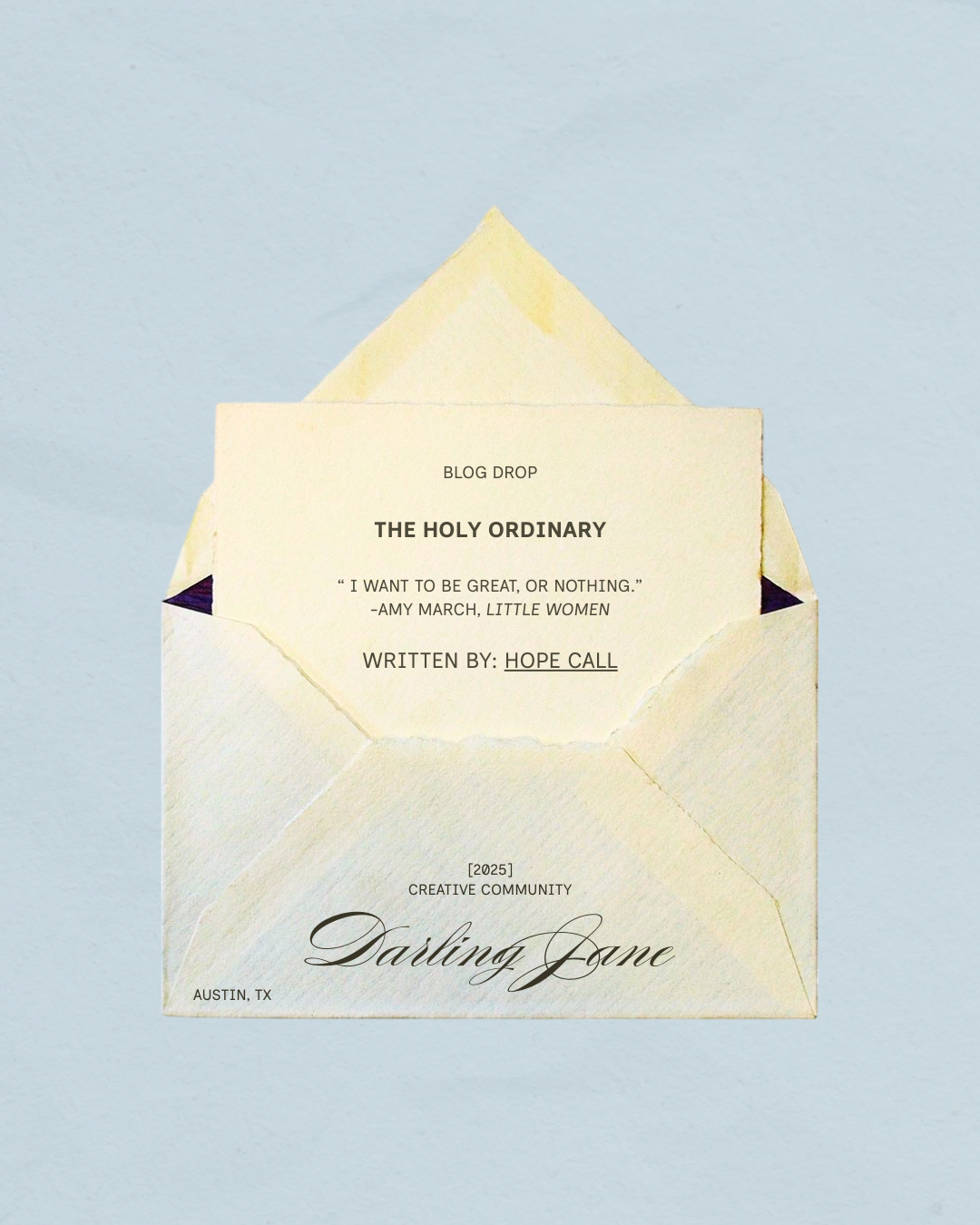
“I want to be great, or nothing.”
– Amy March, Little Women
I used to identify with this line from Greta Gerwig’s rendition of Little Women, a film adaptation of the novel by Louisa May Alcott. Splattered across my Pinterest feed on aesthetic photos of wildflower fields, the words etched themselves into my brain. It reads as some sort of Sylvian call-to-action, an internalized mantra pushing me to be great like the wonderful women in the book. As a self-prescribed “Amy,” I thought relating to this quote meant I was ambitious. Disciplined. Special, even. But lately I’ve realized something uncomfortable: that quote isn’t about passion—it’s about pressure. It is about worth being tangled up in achievement, and anything unremarkable or unimpressive being quietly, unceremoniously discarded—being nothing.
Capitalism trains us early, whispering that our value can only be measured by our output. That joy must be justified, and hobbies are only respectable if they are profitable, impressive, and utterly exceptional. Painting is impressive as long as you sell prints and make it into a gallery. Playing guitar is enticing as long as you are talented enough to perform. Writing is only exciting if it goes viral or is published. Otherwise, what’s the point?
But what if the point is just…the point?
What if we let ourselves do things because they feel good, even if we are only ever mediocre? What if we stopped demanding perfection from the things we do alone in our room when we’re bored at 10:47 pm? Is the love I feel when I pick a guitar string, or thumb through my ever-growing TBR pile, or draw messy, ugly doodles in the margins of my calculus notes enough to justify the act itself? This kind of love and connection is seamlessly ordinary. It doesn’t begin with performance and doesn’t wait for applause.
The other night, I tried (again) to learn the picking pattern for Led Zeppelin's “Going to California.” And (again) I couldn’t. For the life of me, I couldn’t get it right. My fingers felt clumsy, the rhythm elusive, and I desperately needed to trim my fingernails. I flopped onto my bed, dramatically defeated. There she was again: Amy March. The relatable, embarrassingly American, culturally ingrained, voice inside my head that says if you can’t be great, don’t bother. But why does this have to be great? Why can’t this just be…mine?
I want to be baptized in the things I love. Not a disciple of greatness, but one of joy. To dabble. To explore. To experiment without expectation. I want to mess around with oil pastels, take a jazz dance class, attempt mom-blog recipes, even if I am mediocre at best.
It is so incredibly freeing—hobbies were never meant to be battlegrounds. They are social, soulful, slightly silly spaces where people meet and soften together! Craft nights with friends and casual book clubs are where our most sacred friendships form and are reinforced. When these things become too self-centric, obsessive, and draining, we lose out on the social capital humans desperately need. I have definitely found myself caught in the constant comparison game, especially with social media at play: Who’s best? Who’s most talented? Who deserves to be seen? Is it me?
But joy doesn’t need a ranking! And the wildest part is: real growth tends to come from joy, not punishment. I write my best pieces when I let myself flow, not when I’m chained to deadlines and doubt. I feel strongest in my body when I move because it feels exciting and empowering, not for a specific body type or external validation. Progress is a side effect of pleasure, not pressure.
I never used to label myself as creative because I didn’t think my creations were impressive enough to stand as proof. But you do not have to be exceptional to create. You do not have to monetize a passion to make it valid, and you do not have to turn everything you love into a performance.
Do it badly, do it alone, do it together, do it because it feels good. Get baptized in the things you love, and don’t demand perfection from the holy.