The Met's Moral Contradiction: Can We Talk About Art When the Sponsor is Amazon?
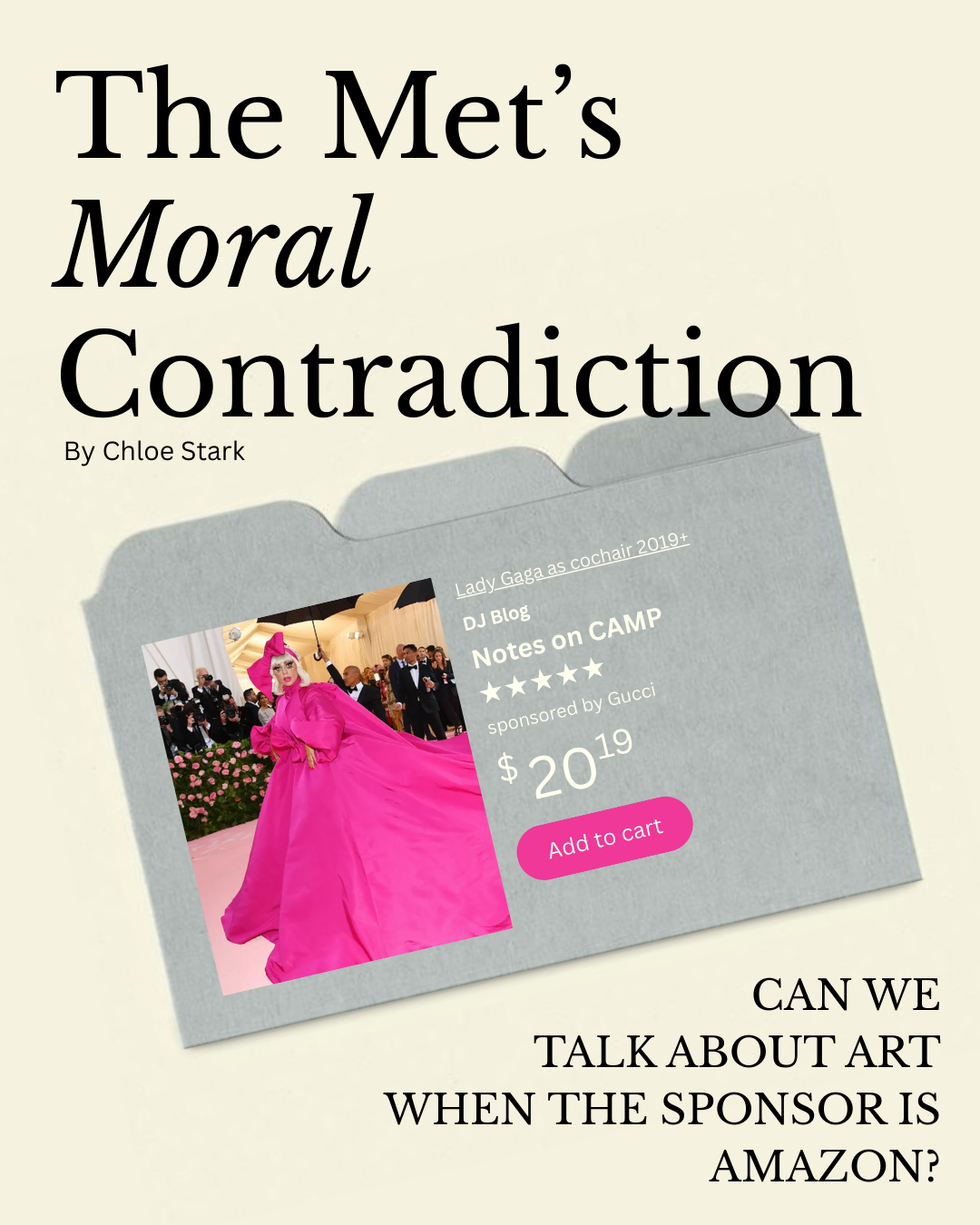
The theme of the 2026 Met Gala, "Costume Art," has real cultural potential. The goal of this year's exhibition is to give the work of tailors, designers, and costume artists the same cultural status as that of painters, sculptors, or top fashion houses. A significant shift away from traditional couture and toward true avant-garde "anti-fashion" as art is to be expected on the red carpet, and I personally believe that this will be a big moment in Met history, if executed properly. In general, the Met seeks to question current creative hierarchies and redefine the definition of elite culture by bringing craft and costume to the very top of high culture. In theory, the topic offers a societal change by recognizing creative and labor practices that are often left out of typical artistic recognition; however, there is a clear disconnect in Jeff and Lauren Sánchez Bezos' major sponsorship. An event intended to criticize elitism is being supported by the very power structures that produce global inequality. Therefore, the exhibition's message is undermined by its framework.
Per The Met itself, the main aim of the "Costume Art" subject is to question the separation between "high" art and "low" art (The Met). Costume design and tailoring, which are sometimes seen as simple or commercial, do not typically receive the same institutional respect as "fine art." The Met's emphasis on these crafts is an attempt to take creative authenticity beyond traditional media to artists who use fabric, fit, labor, and technical knowledge. It seems likely that designers whose creations are already in museum collections, and pieces that were originally meant to be studied rather than worn, will participate and exhibit their talents at the event. By giving historically underrepresented kinds of creativity attention and supporting a broader sense of cultural creation, this change may have a major effect on how society appreciates creative work. There is a genuine and significant chance that the theme could lead to changes in society.
This commitment, however, continues to exist in a museum setting that is becoming more and more influenced by corporate and billionaire funding. Art galleries now rely more on private donations for funding, often at the expense of their institutional independence (Smithsonian Magazine). To try to avoid upsetting benefactors, critics have stated that corporate sponsorship risks impacting artistic choices and artistic narratives, and this establishes a transactional relationship between museums and sponsors in which financial capital is exchanged for artistic image. According to this perspective, rather than serving as venues for serious cultural studies, institutions face the risk of becoming platforms that justify powerful sponsors.
This issue is important for understanding why the sponsorship of the 2026 Met Gala has caused such concern. One powerful example of this dynamic is the involvement of Jeff and Lauren Sánchez Bezos. Amazon's labor policies, environmental impact, and contribution to economic disparity have all drawn harsh criticism. A conflict develops when a billionaire whose wealth stems from such a corporate framework represents an event honoring artistic endeavor. The event is funded by one of the most powerful beneficiaries of global labor inequality, despite the topic honoring craftsmanship, work that has historically been underappreciated, underpaid, and frequently carried out by underprivileged populations. Some claim that this sponsorship presents a danger of "artwashing," which is the act of using cultural institutions to minimize or hide negative impact on reputation (Shotwell). In this setting, the truth of who is funding "Costume Art" seems to overpower the Met's attempt to elevate it.
When one considers the Met Gala's cultural impact, the issue becomes even more obvious. The event presents itself as a forward-thinking force in art and fashion, influencing stories about creativity, inclusivity, and identity. However, that progressive message is more difficult to maintain when its financial foundation is based on excessive wealth. The Met's sponsorship structure supports the very structures it aims to challenge, despite its stated goal of improving artistic acknowledgment. The Gala is at risk of reinforcing the belief that elite institutions can only operate through the funding of the ultra-wealthy, rather than increasing cultural access. This would continue a cycle in which cultural influence exists mainly among a handful of influential, wealthy donors.
Corporate sponsorship supporters might argue that massive projects would not be possible without contributors like Bezos and that big displays require significant funding. In fact, there is still a lack of governmental funding for the arts in the US, which forces organizations to look elsewhere for assistance (Smithsonian Magazine). I recognize that it is now challenging for museums to find sponsors whose values fully align with their cause, but this being said, there should be more funding choices in the art and creative industries, and in the meantime, choices should be made more wisely. The question is whether museums should rely on sources whose wealth contradicts their claimed purpose, not whether they require funding, and the conflict between the subject and sponsor of the 2026 Met Gala is too important to overlook.
In closing, the Met Gala's acceptance of "Costume Art" offers an important chance to rethink what forms high culture. However, by connecting the event to the exact ideas of inequality it seeks to address, Amazon's founder's sponsorship poses a threat to the potential of this year’s event. Cultural institutions must address the implications of who pays for their work if they hope to assert moral and artistic leadership. On the terms of those who profit from the current systems, genuine cultural change cannot take place, and in order to truly empower the arts, new forms of funding which allow institutions to question authority rather than depend on it are just as important as new themes.