The Baroque: Eroticism as the Divine Feminine
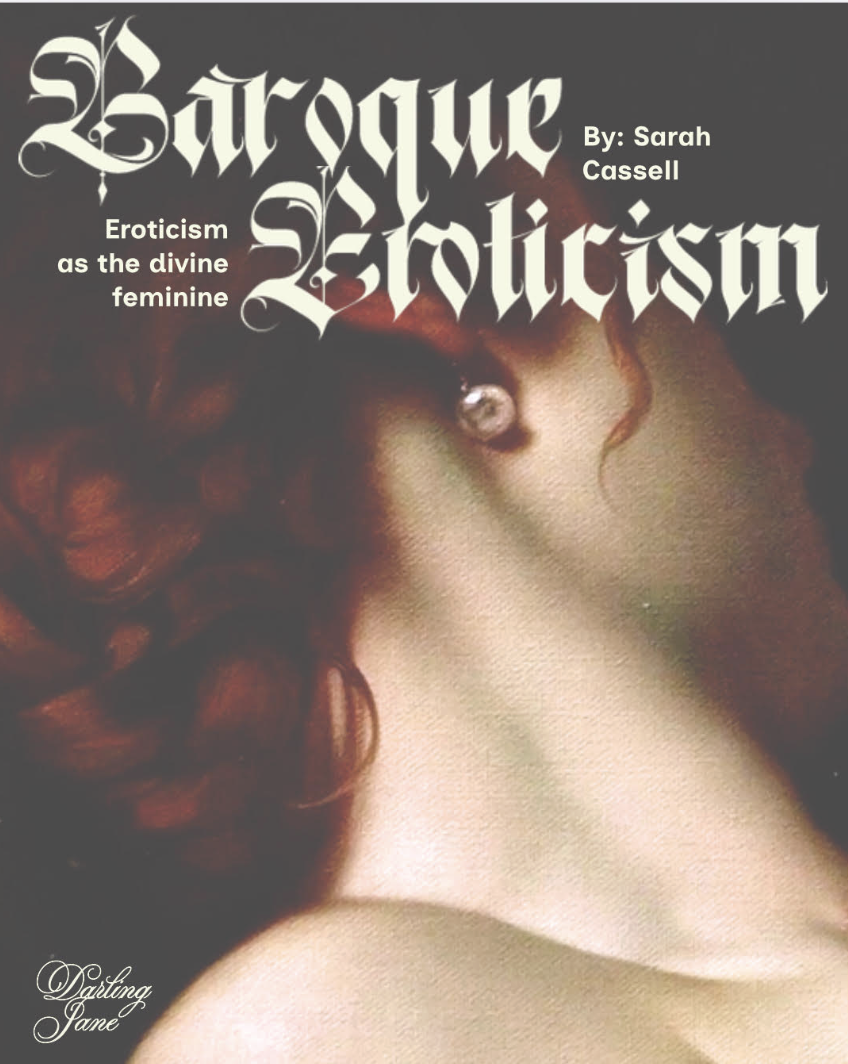
Often associated with its brilliant colors, enlightened eye, and the religious worship of Christianity, the Baroque period has one of the most extensive bodies of scholarship in the art historical world. The Western canon flourished during this time, with its artistic record largely influenced by the widespread devotion to Catholic piety (Sorabella 2003). When “Baroque” is conjured in the mind, many ignore the largest tool that the period relied on as a means to communicate with the audience, love and eroticism. While the average viewer might believe this period of religious piety led to conservatism and traditionalist values, the explicit experience with eroticism courses through the canon of artwork.
Art from the period shows how the connection of emotions with the psyche urges the viewer to form a personal relationship with a piece. The erotic eye is the most powerful tool in these works.
What separates the erotic from other emotions? What makes eroticism a tool so innately powerful? One of the most pivotal texts of the erotic through a modern feminist lens, as I understand it for the framework of this argument, is Audre Lorde’s The Uses of the Erotic. In it, she defines eroticism as a power to disrupt external systems of oppression with the force of the internal feeling– one notably spiritual and innately female (Lorde 2000). In the Renaissance, where women were often objectified in their depictions, eroticism allows for the artistic worship of the feminine as a form of divinity.
Eroticism serves as the language that work speaks, working for many artists of the time, but in particular the works of Artemisia Gentileschi and Gian Lorenzo Bernini. Eroticism is a feeling that is bones-deep, an experience that calls to mind distinct memories, and is intimately personal. The personal feelings of the artist are imbued onto their work to capture the viewer, and these three artists in particular exemplify eroticism in the female image.
These works thrive through paragone, the relationship that varying arts have to one another. Biblical tales and mythology directly informed the paintings or sculptures. Through Gentileschi and Bernini, the distinctly feminine experience synthesizes these tales into a visual masterpiece. In calling on the female being, these artists worship the woman as a subject and as a source of inspiration. The emotions women experience are pivotal to this movement, which identifies the Baroque as one of the most sensual art-historical periods.
This explores the differences in female erotic expression through a female lens versus a male lens—what shifts in work when one’s own experience with gender is different? Gentileschi differs in viewpoint from Bernini as she directly engages with the female erotic in her own life, as one of the most celebrated painters of the century (Artemisia Gentileschi (1593 - 1654 or later) n.d.). This post will favor the female painter’s perspective, exploring Danaë and The Inclination, although Bernini’s experience as a man does not prohibit him from understanding and recreating the female erotic, which we see in The Ecstasy of St. Theresa.
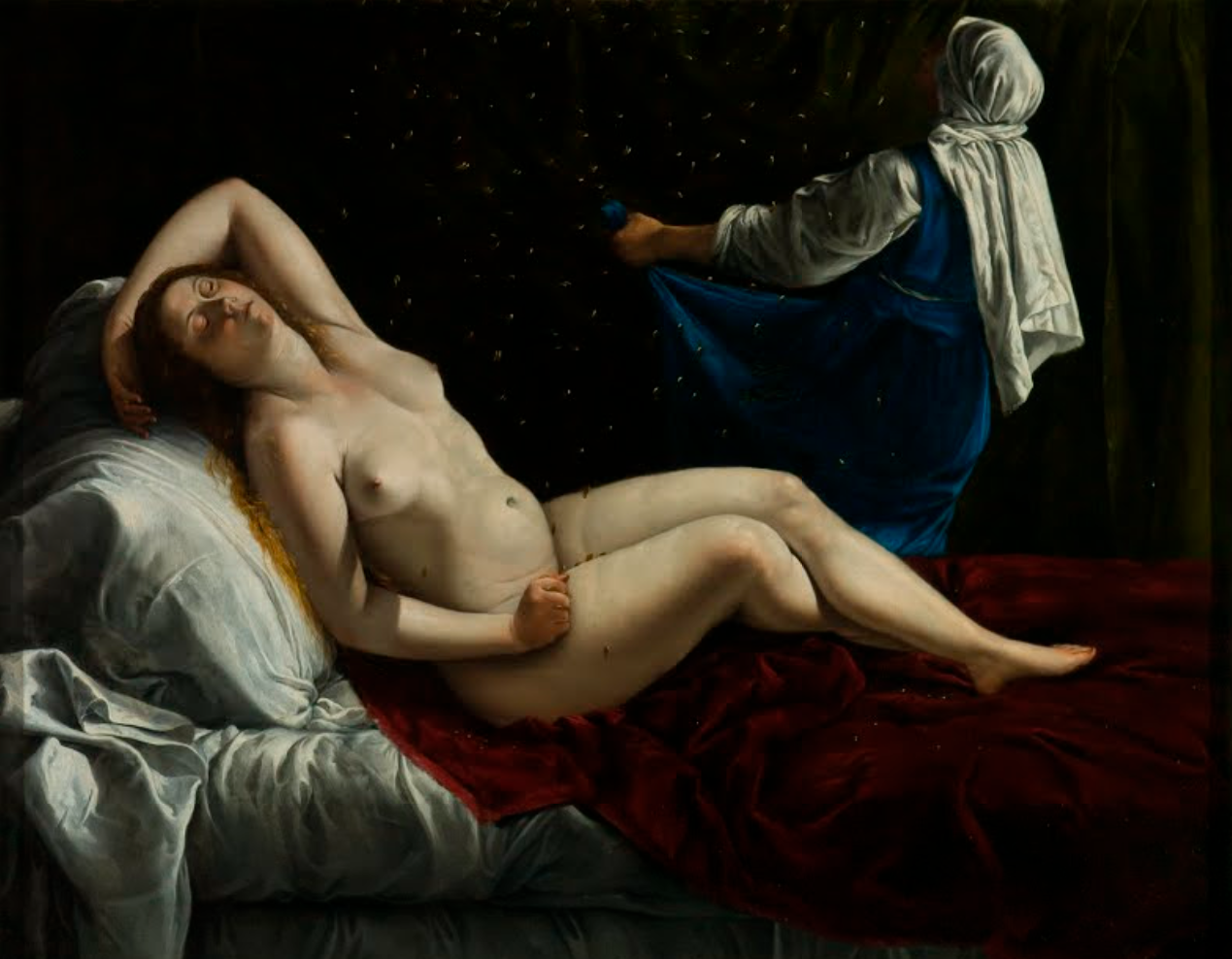
Gentileschi’s Danaë recalls the story of a girl who is locked away in a chamber to prevent her deflowering, but is ultimately visited by Zeus, interpreted here likely as the Roman Jupiter, who visits her as a shower of gold (Gentileschi 1612). In this transformed state, he impregnates Danaë. We see this moment of their sexual encounter enhanced by the female erotic. The image is highly sensual, with her head thrown back in pleasure, her legs curling inwards, and with the softness of the body evident. Jupiter comes in the precious metal, gold, perhaps conveying to the viewer his power as king of the gods and importance to Danaë. Danaë has disrupted her father’s hold, fearing her sexuality, and the eroticism that we see her experiencing exemplifies the erotic as power.
The body commands the composition, stretching out across the length of the image and taking up the central section. While the scene depicts an intimate moment between both Danaë and Jupiter, the artistic focus is on Danaë’s eroticism alone.
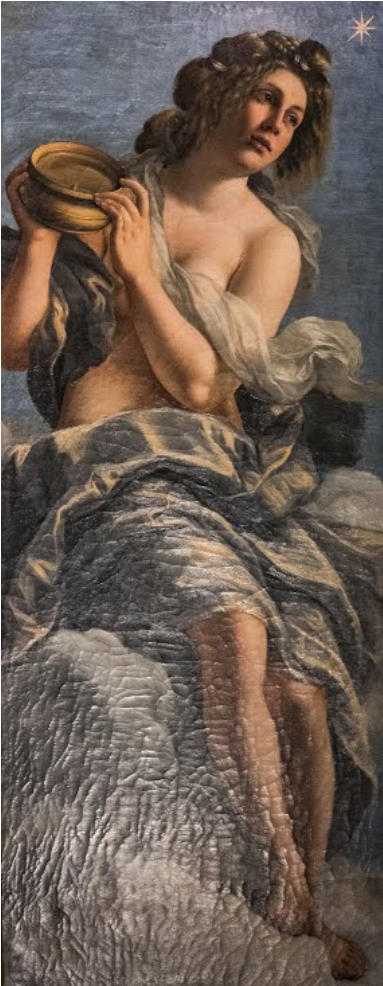
While many scholars debate over Gentileschi referencing her own body for many paintings, The Inclination is largely agreed to have been her second painting, where her own body was the muse, following Susanna and the Elders (Cropper 2001). While Susanna depicted the body as covered up in fear, ashamed, The Inclination loudly depicts the naked female figure, bowing to the feminine as the divine. The painting was commissioned to celebrate Michelangelo Buonarroti the Younger, who had painted a subject deriving from Cesare Ripa’s Iconologia. The image is sensual and feels viscerally real, shocking Florence upon its unveiling (Cropper 2001). Her dark eyes draw in the viewer as she gazes through her lashes, fingers curled, and her knuckles dimpled. Gentileschi expressing the subject through such an erotic lens engages with the viewer directly, inviting them in to follow along in her anticipation.
The painting was so emotionally evocative that Leonardo Buonarroti, who had inherited the palace where it was displayed, had clothing painted over the figure. Cropper argues that this defeats the purpose of the painting entirely. Despite the covering ultimately changing the painting entirely, the tangible emotional response from an audience must be recognized– the female erotic was so powerful that it could not be handled by its viewers.
In both of these examples, Gentileschi likely used her own body as the model. The process of a self-portrait is intimate in itself, forcing the artist to scrutinize their own body in deep detail in order to create a masterpiece. Yet even after the birth of her second child, she is dedicated to depicting the body with honesty and accuracy for The Inclination (Cropper 2001). In painting the true female body through the lens of eroticism, Gentileschi asserts that the natural female nude is a work of art. The nudity is intentional, meant to bare the woman’s soul, and the emotions that one feels when engaging with the works cannot be covered up by the drapery of clothing.
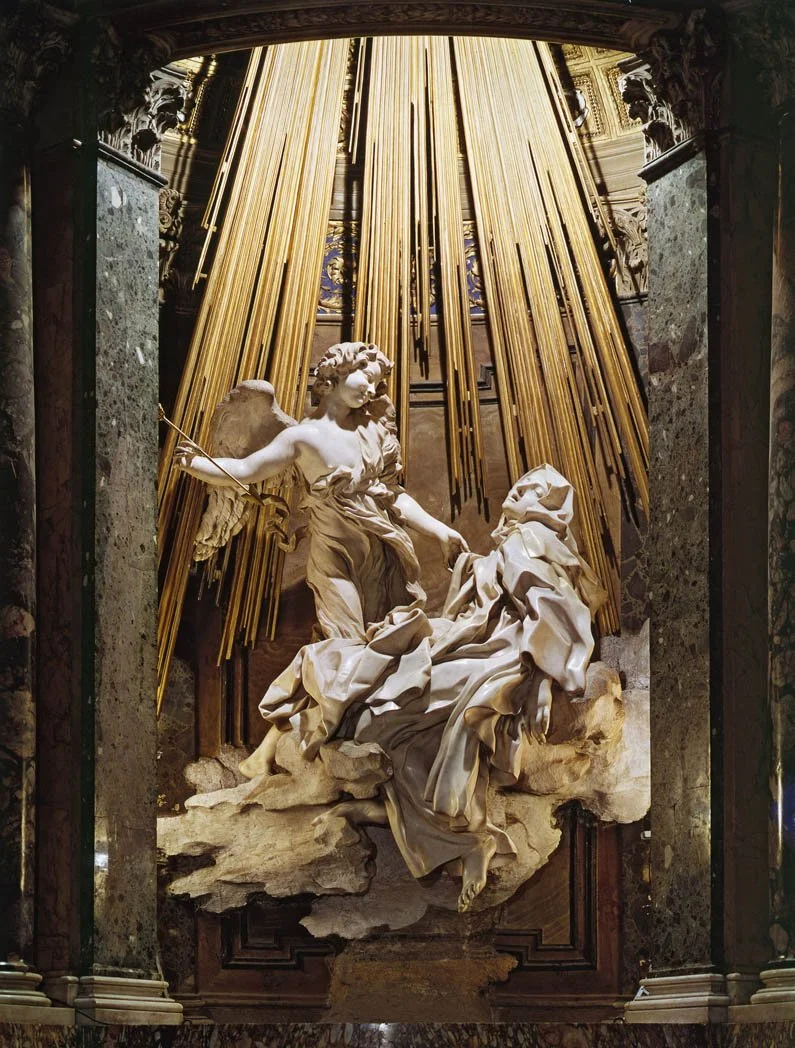
Eroticism in the female figure cannot be discussed without mentioning one of its most famous examples: Bernini’s Ecstasy of St. Teresa. While Bernini does not undergo the intimate process of serving as his own live model, he seems to have a keen understanding of female anatomy. Despite working with marble, he has an incredible ability to form plasticity in the figure, with St. Teresa’s figure in motion as seen by the folds of her habit as heavily draped, moving as she receives the plunge of the angel’s arrow (McPhee 2025).
Her head is thrown back, lips slightly ajar as she appears to gasp in anticipation. The Saint’s fingers and legs curl without any solid direction, showing the very moment that she has reached a point of ecstasy. We are gazing at the inspiration for Teresa’s religious piety in realizing that her “soul cannot be content with anything less than God” (McPhee 2025). In watching St. Teresa experience such pleasure, the viewer strives to feel the same. Her emotional reaction is the focal point, with eroticism as the key commandment for personal engagement with its audience.
As he does not understand eroticism as we have defined it, which hinges on the innately female experience, he lets the first-hand recount of someone who does understand it as a guide. Referencing the primary source of St. Teresa’s autobiography differs from how we have seen the female subject depicted in the past. This is a modern woman’s personal recount rather than an interpretation of a mythological moment or an allegory. While the moment is real, the artistic composition and scene that Bernini sets feels purely mystical. The sunlight streams in from Bernini’s hand-crafted window, golden beams raining down upon her. This use of belle compasto, utilizing multiple mediums within one piece, captures the viewer’s attention. St. Teresa’s ecstasy guides the viewing of this image, as if we are experiencing her erotic vision alongside her.
While a myth is not directly referenced here, some scholars argue that there is an illusion to the Roman art principle of Divine Love. If this is the case, Bernini then calls on the Roman female figure to emphasize the female erotic. He uses syncretism to take away an audience’s original associations with Divine Love and its relevance and reapply it to this scene of St. Teresa’s vision. Bernini expertly moves between time periods in this way to create an eternal artwork evoking religious piety.
The Baroque period serves as proof that eroticism is not something that was hidden or looked down upon, but something that flourished. Gentileschi and Bernini in particular exemplify that the art world’s most important works are those that elicited a deep emotional reaction, and it is clear that eroticism was a potent tool to do so. The erotic is the ultimate weapon to garner audience engagement, as it intimately calls upon the personal experience, making separating oneself from art entirely impossible.
“Artemisia Gentileschi (1593 - 1654 or Later).” The National Gallery, https://www.nationalgallery.org.uk/artists/artemisia-gentileschi.
Bernini, Gian Lorenzo. Ecstasy of St. Teresa. 52 1647, Cornaro Chapel, Rome, https://www.learner.org/series/art-through-time-a-global-view/dreams-and-visions/the-ecstasy-of-st-teresa/. Marble, stucco, and gilt bronze.
Cropper, Elizabeth. “Life on the Edge: Artemisia Gentileschi, Famous Woman Painter.” Orazio and Artemisia Gentileschi, edited by Keith Christiansen et al., Yale Univ. Press, 2001, Exhibition Orazio and Artemisia Gentileschi - Father and Daughter Painters in Baroque Italy, New Haven, [Conn.], pp. 263–81. K10plus ISBN.
Gentileschi, Artemisia. Danaë. 1612, The National Gallery, London, https://artsandculture.google.com/asset/dana/FwH_pa7uE_N8nw. Oil on copper.
———. The Inclination. 1616 1615, Casa Buonarroti, Firenze, https://artsandculture.google.com/asset/the-inclination-artemisia-gentileschi/sQE3jVlTXkyJkA. Oil on canvas.
Lorde, Audre. Uses of the Erotic: The Erotic as Power. Kore Press, 2000. K10plus ISBN.
McPhee, Sarah. “Introduction to the Baroque.” University Lecture. Atlanta, GA.
Sorabella, Jean. “Timeline of Art History: Baroque Rome.” The Met Museum, 1 Oct. 2003, https://www.metmuseum.org/essays/baroque-rome.