In open D tuning, “Cactus Tree” by Joni Mitchell pours out of my guitar, the low E string sonorous throughout the half-full bar. Seamlessly shifting from my chest to my head voice, only slightly discordant, I feel magic. Harmella—the strong-minded and raucous woman who went on before me, singing a carnal, jazzy, outrageous ode to her many (many) lovers—whoops and hollers when I hit the G5 note. After at least six mis-strums and one lyric misspoken, I grin and giggle as I walk off the 7-by-5-foot stage.
The elusive “local music scene.” Whether in a solo-cup-littered backyard in my college town of Eugene, Oregon, or a dimly lit cabaret bar in my hometown of Ketchikan, Alaska, you can hear the crescendo of people connecting over a love of music. A corner of jazz and fun and singing and sexual innuendos, featuring an old man dragging a huge bass up to the open-mic sign-up sheet; a crunchy country man who can’t quite hit the note; and (my favorite) the 20-something-year-old boy who seems ugly-hot until he starts picking his electric guitar—then he’s just hot.
I have never felt a higher level of community than at an open mic. It transcends age, political party, income, and genre. Sandwiched between slews of amazing spoken word poetry and painful, ear-splitting standup, you find yourself standing in front of a group of strangers wringing all the vulnerability out of your body. Safe in the communal expectation that no judgment may enter a room of willing music, we sign a contract promising to only encourage one another’s creativity.
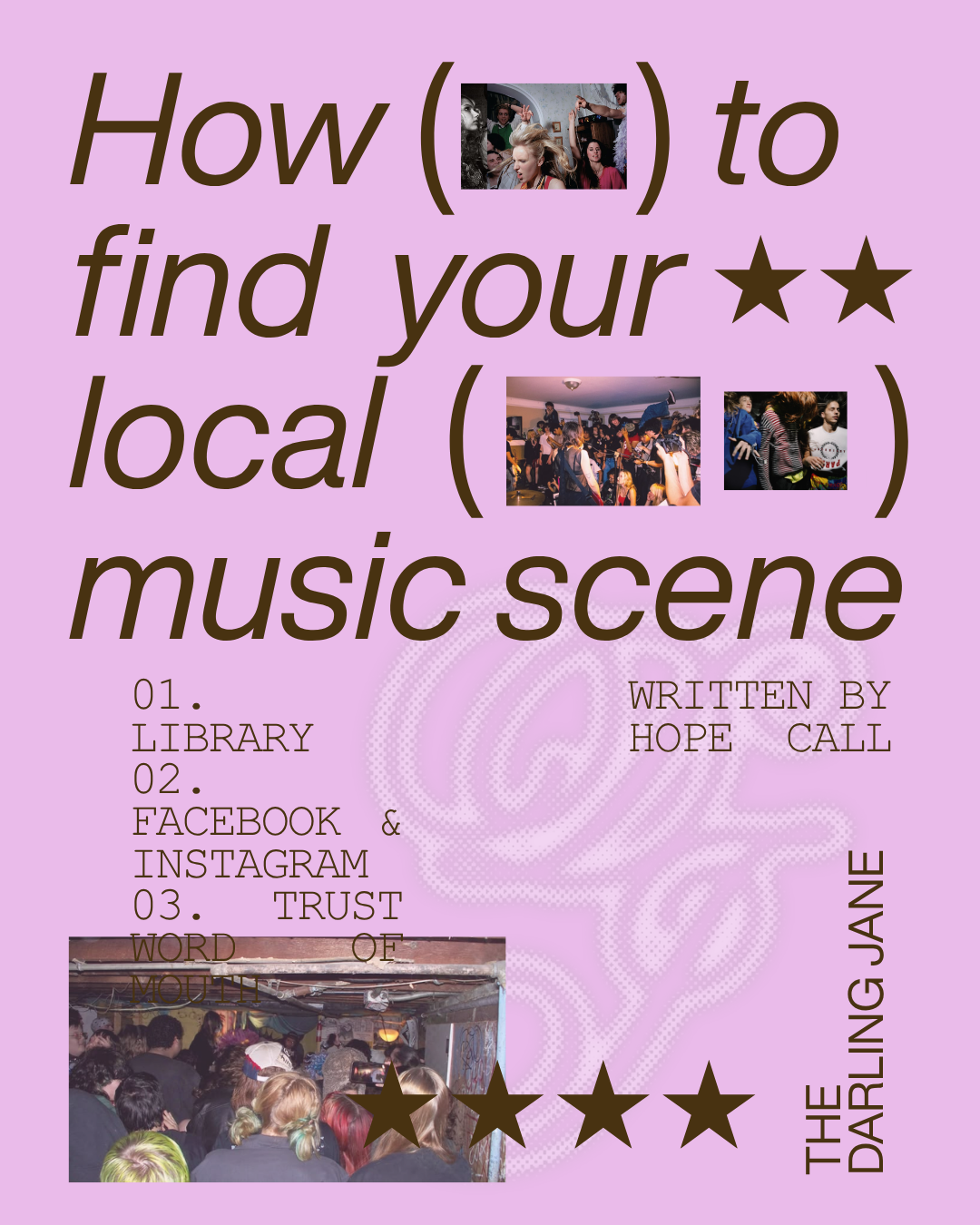
Beyond the fortuitous stumble-upon of a neighborhood troubadour busking the streets, it can be intimidating and difficult to find local music. So: How do you find your community’s local music scene? Whether you're a performer or an observer, everyone needs their live music fix.
Best starting point: THE PUBLIC LIBRARY. This is where the most up-to-date community bulletins will be—corkboards stacked floor to ceiling with flyers for open mics, house shows, small concerts, youth clubs, and live radio advertisements. Worst case, you leave with a pull-tab for a karate drop-in, ceramics class, or downtown apartment (you’ve been looking for a place to sublease for the winter!).
Instagram and—I hate to say it—Facebook. Instagram accounts with keywords [YOUR TOWN] + house-show, live-music, open-mic, etc. are typical spots where young people spread the word of live performances and new music. But good music isn’t just for 20-somethings. Remember, the best stuff spans age groups: you’re not going to find the old man with a three-foot beard playing fiddle in a coffeehouse on Instagram. Facebook groups are often where the coolest music aunts and uncles post about local shows, theatre, and open mics.
Word of mouth. Ask around. There are so many different branches of any town’s music scene. In Eugene, I first heard about the legendary “houseshow” from my friend Heidi. Hearing the bands “Verb8m” and “10 or 11 Deer” play live tore me into the houseshow scene. And now, my Friday nights are reserved for dancing with 100 sweaty college kids downing beers in a generous senior’s backyard (poor girl—she’ll be cleaning all this up through a pounding hangover in the morning). But maybe listening to “Cosplay Jesus” and “The Joint” tear up electric guitar solos in a mosh pit isn’t for you. Maybe instead you want to have a calm glass of wine at one of The Jazz Station’s Wednesday Jam Sessions on W Broadway. Or, for a more casual feel, head over to Gratitude Brewing if poetry, Appalachian guitar, and some Big-Thief-infused peppermint tea is more appealing. Ask around, you’ll find your pocket.
This past summer, on returning home to Ketchikan, Alaska, I found my pocket at Creek Street Cabaret. Every Sunday, I was there, asking the host band to join me onstage for a belty Fleetwood Mac cover and grinning through an opt-up. Most people perform better in private than in front of a crowd, but in this dimly-lit bar—due to lack of reliable electricity, not intentional ambiance—I found that I’m the opposite. Something about a roomful of my people clapping on 1 and 3, nodding their heads and grinning back at me as I hammer out an entropic Annabelle Dinda medley, ignites me. Sadly, this is less about my musical talent and more about the cabaret environment. Find where you feel safe enough to let creativity seep out of you—regardless of talent or experience.
We are all contributing writers in the local music manifesto. Whether it's 2 a.m. sloppy bar karaoke, sophisticated flamenco guitar riffs at a VIP club, or an elementary school’s rendition of The Music Man Jr., live music is for everyone.